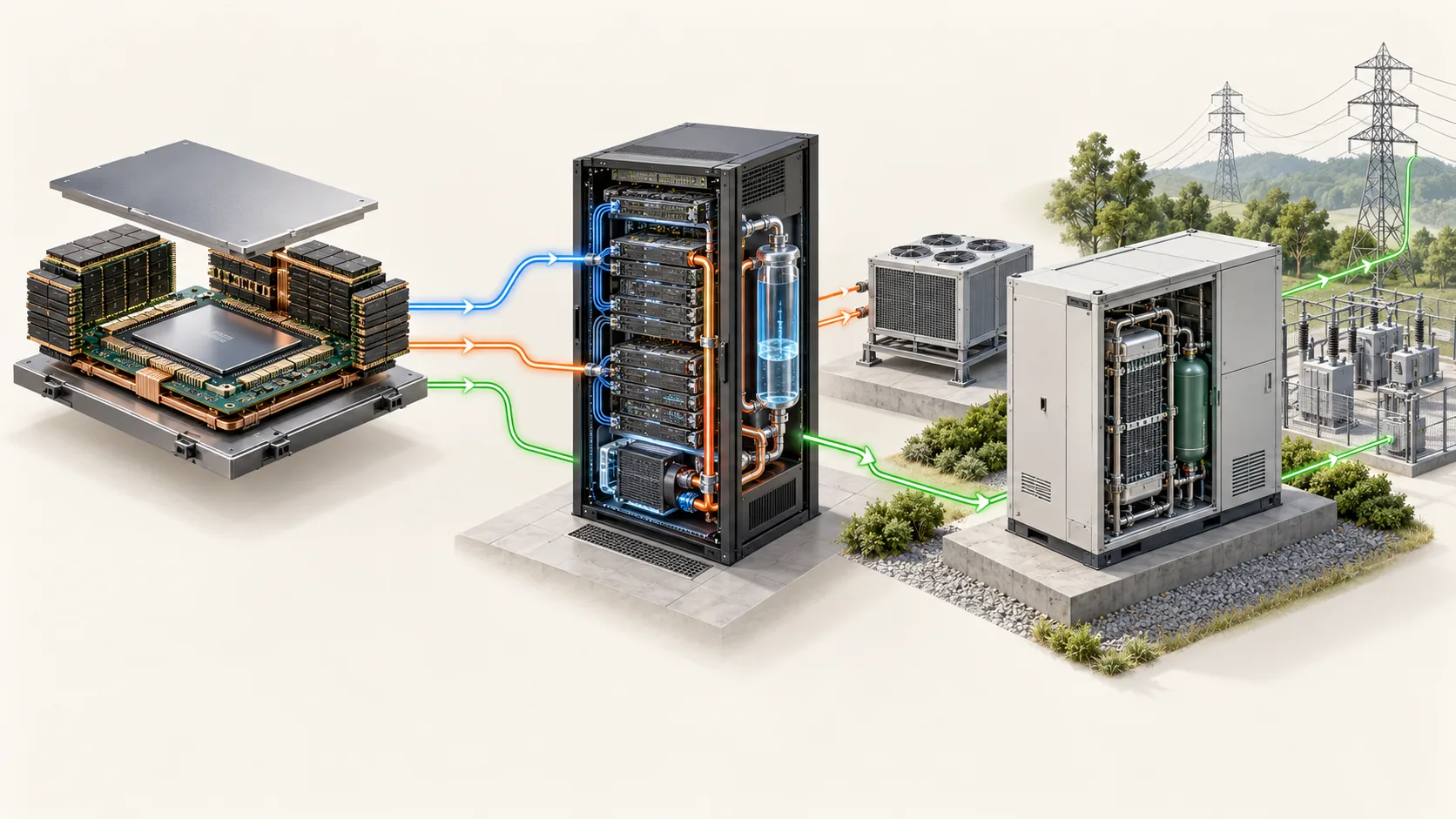
AI-generated conceptual illustration. Resource relationships are simplified; it does not show an actual data-center installation.
Name the constrained stage and the evidence that would change it
“Power comes next” or “optics comes next” can be useful hypotheses, but only after naming where the delay occurs. Power generation, grid connection, transformers, switchgear and rack distribution have different capacities and delivery times. Optical bandwidth, laser production, packaging, module test and customer qualification also form different queues. A bottleneck can move when one queue is shortened. Increasing compute supply can expose communication limits; adding communication bandwidth can expose software or memory behavior; energizing a site can expose cooling limits.
For Bloom, a favorable case requires customers to value earlier available power, the system to meet the actual operating contract and installations to translate into accepted systems with sustainable service economics. Fuel availability, permits and reliability are constraints, not footnotes. For AAOI, a favorable case requires demand for the relevant optical interfaces, successful qualification, good-unit production and cash collection. A faster Ethernet standard by itself establishes none of those company-specific outcomes.
Make the bull case operational
Bloom's June 2026 filing separates product, installation, service and electricity. A research card should ask whether the mix that produces consolidated gross profit also supports continued deployment and service obligations. A reported partnership is not the same as an unconditional order, commissioned output or collected cash. Customer-linked warrants can also alter the economics of a relationship and the diluted share count. Read the specific note rather than treating all contracts as identical backlog.
AAOI's June 2026 filing gives second-quarter revenue of $191.922 million and gross profit of $53.207 million, against first-half operating cash use of $73.781 million. The periods are intentionally stated separately. A revenue ramp with cash consumption is not automatically a failed business, but it raises a funding and execution question. Which combination of qualification, utilization, yield and collection would allow the ramp to generate cash? Which balance-sheet or production observation would contradict that path?
- 1Demand signal
- 2customer qualification
- 3usable capacity
- 4accepted delivery
- 1Accepted delivery
- 2realized gross profit
- 3working capital and investment
- 4cash
- 1Cash trajectory
- 2diluted ownership
- 3expectations embedded in price
A bottleneck can attract capital and then lose scarcity
When customers pay to remove a constraint, competitors have an incentive to expand supply or offer substitutes. More production can reduce scarcity rents before demand stops growing. A component supplier may sell more units at lower margins. A customer may use copper for a short link, a different optical architecture for another distance or software changes to reduce communication. An on-site generation solution may face changes in grid availability, fuel economics or permitting. The next scarce resource is therefore a scenario about substitution and timing, not a permanent ranking of tickers.
Build a three-stage teaching case: at first, packaging limits accelerator deployment; after packaging expansion, energized rack capacity limits deployment; after energization, optical qualification limits distributed-system expansion. This is an invented scenario, not a claim about the global sequence in October 2026. At each stage list who has excess capacity, who can charge for the constraint and who must invest before being paid. Look for evidence that two constraints operate simultaneously rather than forcing the world into a single queue.
Reverse expectations instead of promising a winner
An original valuation example uses enterprise value of 10 billion monetary units, annual sustainable cash flow of 0.5 billion and a 20-times cash multiple. If sustainable cash falls to 0.25 billion with the same multiple, enterprise value is 5 billion. Conversely supporting an enterprise value of 15 billion at that multiple requires 0.75 billion cash. These are conditional arithmetic cases and are not BE or AAOI target values. Debt, cash, other claims and diluted shares must still be incorporated before translating enterprise value into equity per share.
Ask whether the operating evidence could support the required cash trajectory, and whether funding can bridge the time before it arrives. The current stock price can already assume qualification success and rapid growth. A company can meet an ambitious operating goal and still disappoint a more ambitious valuation. This is why “will BE or AAOI benefit?” and “will their shares rise from this price?” are different questions that need a connected explanation.
A monitoring lab for the next four-hour review
Write five conditions per issuer: demand, delivery, margin, cash and ownership. Link each to the relevant filing or dated issuer announcement. Define a favorable and an unfavorable observation before the next release. Update a condition only when its specific evidence changes; a new social-media post is a discovery signal, not a replacement for qualification or financial disclosure. Record that no material observation changed when that is the truth. The research archive should accumulate better explanations and dated evidence, not increasingly confident repetitions of the same thesis.
VALUATION / HYPOTHETICAL INPUTS
How much does one assumption change value?
Toy model: current annual cash flow 500m, debt 1,000m, cash 200m and 100m diluted shares. EV = cash flow × (1 + g) / (r − g); equity = EV − debt + cash. It assumes immediate perpetual growth and ignores a transition period and other claims. No issuer inputs or target prices are used.
SOURCES
01YOUR NOTES