A separation changes the reporting boundary
SanDisk became a standalone public company on February 21, 2025. Its FY2026 Form 10-K, for the year ended July 3, 2026, says its earlier historical statements were derived from Western Digital records and prepared as if the company had existed standalone. That qualification matters: pre-spin revenue and costs are useful history, but they are not evidence that the earlier cost structure would have been exactly the same independent company.
- 1NAND technology + Flash Ventures
- 2SSD/embedded/retail products
- 3customer channels
- 1WDC shared functions before spin
- 2allocated historical costs
- 3standalone reporting boundary
The filing groups FY2026 revenue into Datacenter ($5.153 billion), Edge ($12.160 billion), and Consumer ($2.935 billion), totaling $20.248 billion, all GAAP revenue figures in millions of U.S. dollars. Datacenter includes public/private cloud and enterprise; Edge includes OEM and channel flash products across PCs, mobile, gaming, automotive, physical AI, home entertainment, and industrial uses. Consumer covers retail/end-user products. This is a useful end-market map, not a product-level profit table.
The business is therefore more than “AI storage.” A server SSD may be affected by cloud build-outs and storage architecture; a consumer card or retail drive follows different channel and seasonal behavior. The 10-K says no single customer exceeded 10% of FY2026 revenue, while the ten largest customers represented 44%. Diversification by named-customer threshold does not erase concentration in a group of large customers.
What separation does and does not prove
The 10-K reports that FY2026 revenue rose 175% from FY2025, citing changes in Datacenter, Edge, and Consumer. It separately says the pre-spin financial statements include allocated WDC corporate and shared-function expenses and may not indicate future standalone costs. A reader should hold both facts: historical operations can illuminate demand and gross profit, but a financial model should not mechanically project allocated expense ratios.
The production model also has a boundary. The filing describes Flash Ventures and Kioxia relationships; flash manufacturing, technology investment, inventory, and capital commitments are not equivalent to a simple fabless controller model. An SSD’s customer value comes from NAND, controller/firmware, qualification, capacity, endurance and support. A high NAND price environment can improve reported sales but can also change customer inventory behavior and demand timing.
A worked classification exercise
Make a three-column worksheet. Column one is a claim: “AI increases SanDisk demand.” Column two identifies the nearest disclosed category: Datacenter revenue or a particular customer configuration. Column three names the missing link: controller attach, qualified capacity, exabyte shipments, price per gigabyte, or inventory. For the FY2026 data, do not allocate the $5.153 billion Datacenter result to AI without a disclosed definition. Do not call Edge revenue consumer demand; the filing includes OEM and industrial applications in Edge.
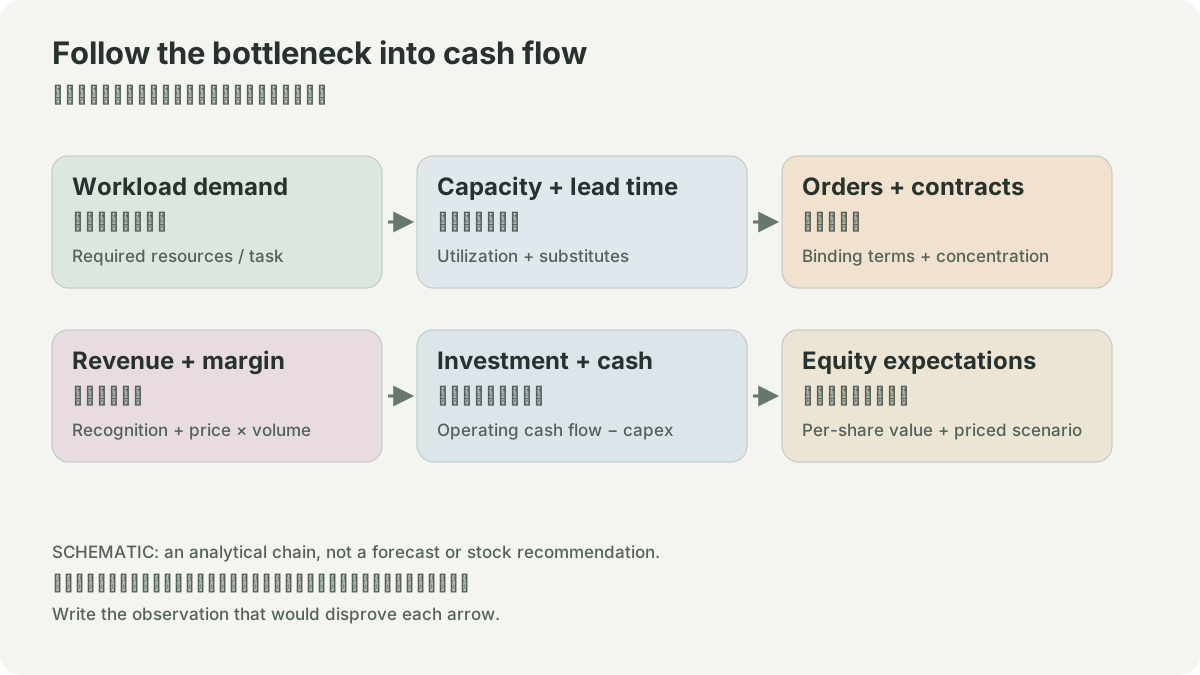
An invalidation test is concrete: if Datacenter revenue grows while products sold or revenue per gigabyte fall, mix or price may differ from the simple AI-demand story. If a comparable future filing changes segment definitions, do not calculate a trend without restating the boundary. The primary source is SanDisk’s FY2026 10-K, not a price chart.
ROOFLINE / HYPOTHETICAL INPUTS
Does memory feed the compute?
Upper bound = min(compute ceiling, bandwidth × arithmetic intensity). Decimal TB = 10¹² bytes. Cache effects, access patterns, communication and actual utilization are omitted; this is not a device benchmark. More capacity does not necessarily increase bandwidth.
SOURCES
01YOUR NOTES