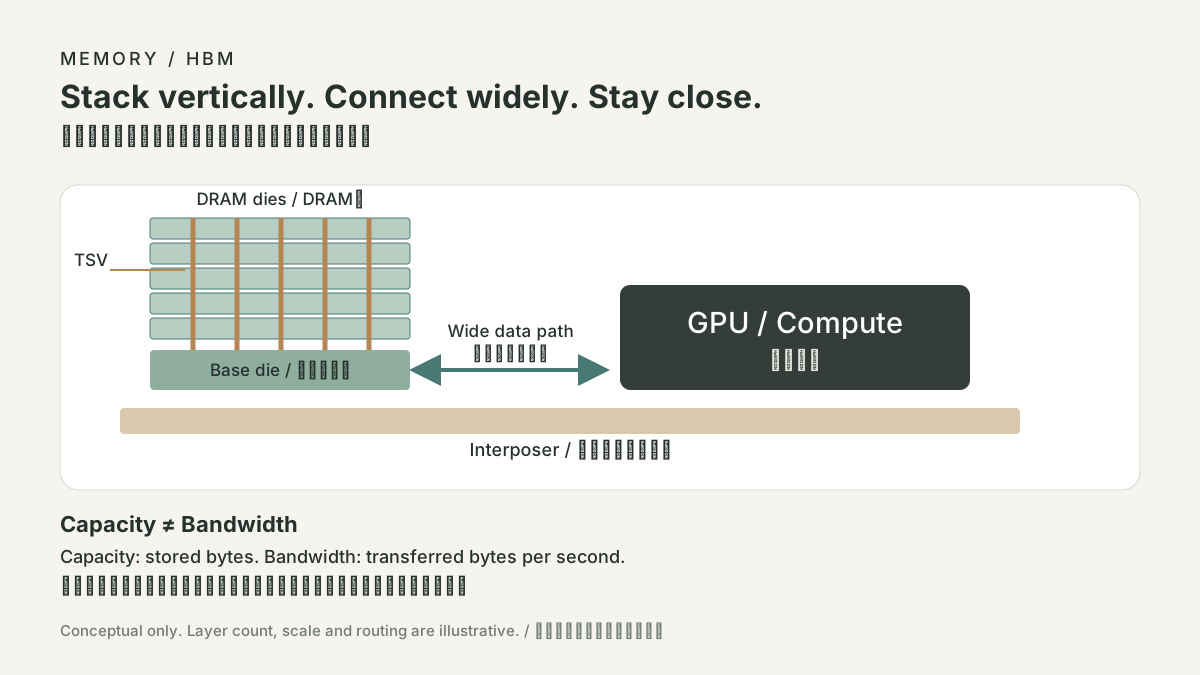
HBM revenue begins with a working system
Micron sells memory products, but an HBM opportunity is not simply a count of AI accelerators. A memory cube must meet an accelerator’s interface, capacity, thermal, electrical, packaging, test, and customer-qualification requirements. The product then has to be allocated, assembled with the platform, shipped, accepted, and recognized as revenue under the relevant accounting terms. Each stage has a different owner and failure mode.
- 1HBM die + base die
- 2stacked package
- 3accelerator qualification
- 4system shipment
- 5revenue recognition
- 1bandwidth/capacity claim
- 2workload evidence
- 3customer configuration
- 4financial result
Micron’s HBM3E page specifies 1,024 I/O pins, more than 9.2 Gb/s pin speed, more than 1.2 TB/s bandwidth per placement, and 24 GB eight-high or 36 GB twelve-high options. Those are product specifications, not a statement of an accelerator’s total memory, a customer’s purchased volume, or a market-share measurement. NVIDIA’s H200 announcement provides a useful separate platform boundary: it says H200 has 141 GB HBM3e and 4.8 TB/s. The announcement does not identify the revenue retained by any memory supplier.
Capacity, bandwidth, and mix are different questions
An eight-high 24-GB cube and a twelve-high 36-GB cube may have related interface properties but differ in die count, stack assembly, capacity and potentially qualification. Increasing HBM capacity can allow a configuration to keep more weights, activations, workspace, or KV cache local. It does not automatically make a compute-bound kernel faster. Higher bandwidth can help a low-arithmetic-intensity workload, but it does not repair a storage, interconnect, power, or software bottleneck. The correct engineering question is where the byte waits; the correct business question is which qualified configuration the customer actually buys.
Use a toy configuration only for arithmetic. If a hypothetical accelerator has six 24-GB placements, local HBM capacity is 144 GB; six 36-GB placements would be 216 GB. That does not imply an available product or a Micron shipment. It simply shows why capacity per placement affects a board-level memory budget. For a company model, add explicit variables for placements per accelerator, qualification share, sellable yield, product mix, price, and period of recognition. Do not collapse them into “AI demand.”
Micron’s FY2026 Q3 results page is the appropriate primary starting point for its dated corporate results. Use the exact earnings release or filing table for any revenue, margin, cash-flow, or guidance number; a product page cannot substitute. Reconcile GAAP and non-GAAP measures before combining them, and retain the fiscal-quarter end date. If a number is unavailable in the selected primary table, call it unknown rather than filling it with an estimate.
A qualification-aware exercise
Build a four-layer worksheet. First, record the system: model, precision, context, batch, accelerator and cooling. Second, record the memory configuration: placements, GB per placement, stated interface rate and stack height. Third, record evidence: product specification, platform document, customer qualification evidence, and filing line. Fourth, write an invalidation condition: another supplier is qualified, the model uses less active memory, packaging capacity constrains output, or the workload is not memory-bound.
The result should read: “Under this configuration, a larger local HBM budget removes this measured residency constraint; if the product is qualified and sold in this mix, component exposure may change.” That is much stronger than treating a bandwidth headline as a company forecast.
ROOFLINE / HYPOTHETICAL INPUTS
Does memory feed the compute?
Upper bound = min(compute ceiling, bandwidth × arithmetic intensity). Decimal TB = 10¹² bytes. Cache effects, access patterns, communication and actual utilization are omitted; this is not a device benchmark. More capacity does not necessarily increase bandwidth.
SOURCES
01YOUR NOTES