Start with the legal entity and its markets
Applied Optoelectronics, Inc. (AAOI) is a listed fiber-optic networking-products company. A useful first discipline is not to turn its ticker into a synonym for a single AI-optics product. Its 2025 Form 10-K identifies four target markets: internet data centers, CATV, telecom, and FTTH. It describes products at several integration levels, from components and subassemblies to modules and systems. Each market has different customers, qualification cycles, price behavior, and technology requirements.
For the data-center portion, the filing describes optical transceivers that connect switches and servers over fiber. It also describes light engines combining lasers and photodiodes, with some configurations including driver electronics, signal amplifiers, and multiplexing functions. That wording lets a reader map a technical stack: laser chip or component, subassembly or light engine, complete transceiver, then the customer’s switch or server system. It does not identify every customer, guarantee a design win, or show the mix of a particular future quarter.
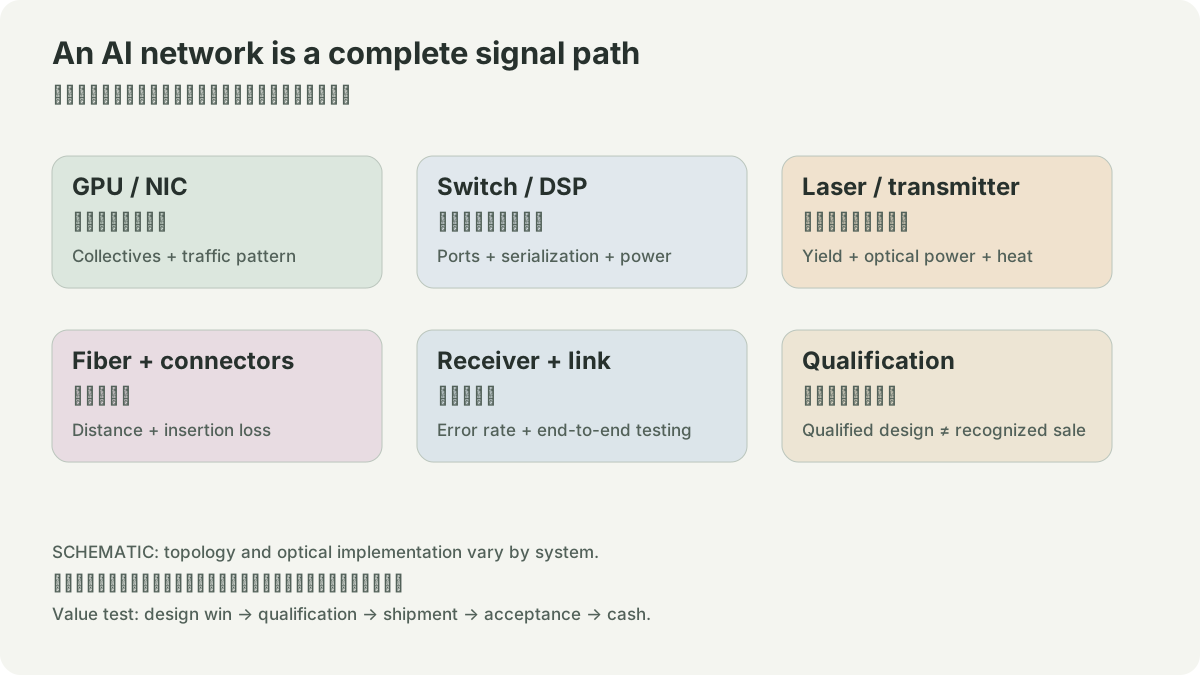
Product, customer, and revenue are different statements
Three statements are often incorrectly collapsed. “A company can make a product” concerns capability. “A customer has qualified a product” concerns an approved configuration and manufacturing readiness. “The company recorded revenue” concerns shipments, acceptance, price, and accounting in a reported period. A press release may speak about development or qualification; a filed statement may describe a market or reported result. Keep the evidence at its own level.
AAOI’s filing describes vertically integrated operations including laser and laser-component manufacturing and research in Texas, and manufacturing of certain data-center transceiver products through Global. It says the company has facilities in the United States, Taiwan, and China. This supports a manufacturing-footprint map. It does not prove that every component is made in-house, that a plant has spare capacity, or that a capacity addition produces sellable modules without yield and customer acceptance.
- 1laser component
- 2light engine or subassembly
- 3complete transceiver
- 4customer system qualification
- 1purchase order
- 2manufacture and test
- 3shipment and acceptance
- 4reported revenue
- 1issuer filing
- 2scope and risks
- 3reader's evidence map
Worked example: turn one filing into a boundary map
Take the 2025 10-K and create four rows: internet data center, CATV, telecom, and FTTH. For each row, copy only what the filing says about the end market, product level, manufacturing location, and named risk. Then add three blank columns: named customer, qualified configuration, and future shipment volume. Leave blanks blank unless a dated primary source explicitly fills them.
Now take the company’s second-quarter 2025 results. The release refers to qualification efforts for 800G products and management’s shipment expectation. Classify that as management communication about its period and outlook; do not rewrite it as proof of an independently measured product ramp. Compare it with the later or earlier filed annual report only after confirming fiscal period and whether the claim is reported history, current status, or forward-looking guidance.
Limits that matter to a business reader
The 10-K says that purchase orders may be short term and subject to rescheduling, revision, or cancellation, and that backlog is not a reliable indicator of future revenue. That is directly useful: a technology transition can raise interest before it raises recognized revenue. Competition, customer concentration, supply inputs, qualification, yield, inventory, price, and working capital can each interrupt the path from product capability to financial result.
The company’s description of vertical integration is also not an automatic margin conclusion. In-house lasers and automated module production can offer control and development advantages, while also requiring capital, process control, and yield discipline. A reader should look for filings that quantify period-specific spending, inventory, cash flow, and concentration rather than deriving them from a product page.
Lab: build a claim ledger
Create a spreadsheet with columns for claim, exact source URL, source date, access date, evidence class, fiscal period, and what the source does not establish. Populate it with one statement each about AAOI’s markets, product layers, manufacturing footprint, and 800G qualification. Do not add a customer name or revenue number unless the cited source states it. This is an evidence-reading exercise, not investment advice or a forecast.
NETWORK / HYPOTHETICAL INPUTS
Port labels and useful throughput differ.
An 800 Gb/s port multiplied by the selected useful fraction. This toy fraction combines idle time and overhead; it is not a measured link or a protocol model. Tail latency, topology, retries and collective algorithms need separate measurements. It cannot predict a supplier’s sales.
SOURCES
01YOUR NOTES