Concentration is a dependency map
An optical supplier can depend economically on a small number of customers while an outside reader cannot responsibly name them. The AAOI 2025 Form 10-K is the relevant kind of record: an issuer filing with a stated period, rather than a product rumor or industry chart. Read its customer-concentration and risk sections for the language actually disclosed. Do not convert a percentage threshold, a distributor reference, or a coincident announcement into an identity claim.
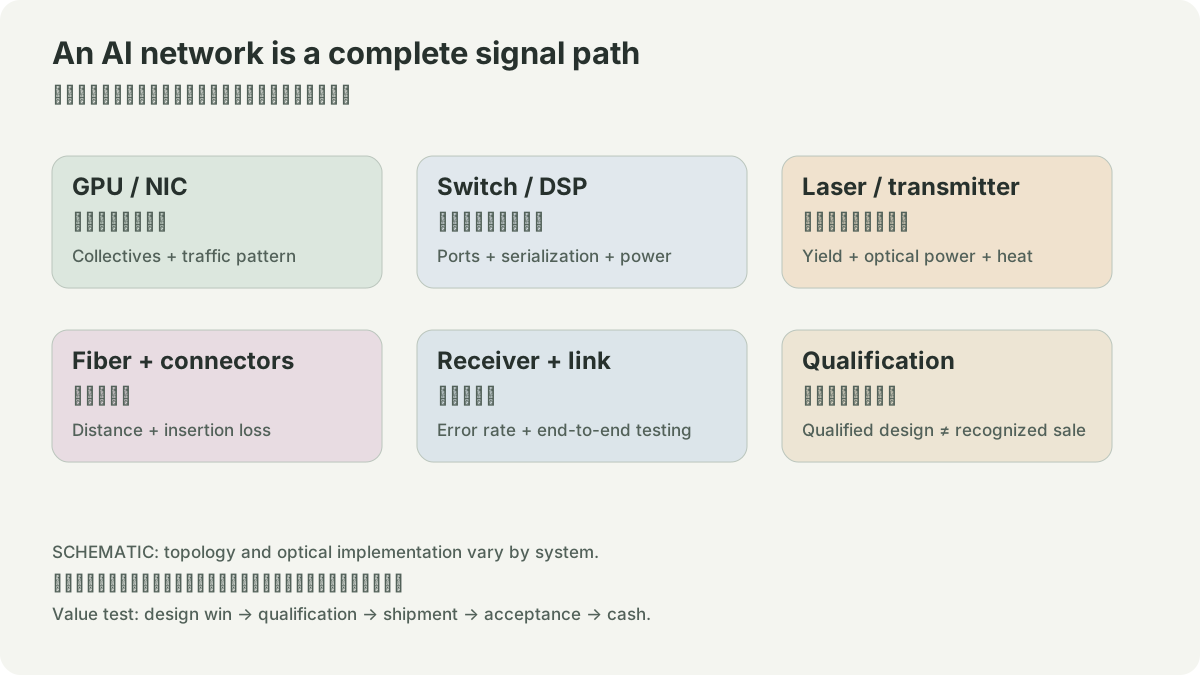
Concentration matters because the physical path has few easy substitutions once a module is qualified. A switch ASIC sends electrical lanes to a module; driver, laser, optics, receiver and control functions turn the signal into light and back; a remote port must interoperate at the chosen rate, reach and thermal conditions. A customer can change a forecast, release a successor design, qualify a second source, or request a price concession. These are different events with different operational effects.
- 1Customer topology and port specification
- 2module design and qualification
- 3purchase release
- 1purchase release
- 2build, test, ship
- 3acceptance and invoice
- 4reported revenue
- 1one large account changes its plan
- 2exposure appears before identity is knowable
Separate four questions
Ask whether a filing reports a customer above its disclosure threshold for a stated period. Then ask whether the customer is direct or served through a channel; that changes the meaning of the concentration. Identify a product family only when the issuer names it. Finally, keep a prospective design win separate from revenue already recognized. A public record may answer only the first question.
This discipline avoids a common optics error: assuming that a hyperscaler name proves a particular transceiver supplier. A network can use several module vendors, cable types, reaches, manufacturing locations and qualification lots. Conversely, a concentrated supplier can sell several product families through one relationship. A filing is evidence of economic exposure, not a bill of materials.
A hypothetical sensitivity
Imagine a supplier with 100 accepted modules in a planning month, 60 associated with one account and 40 spread across others. If the large account defers 20 modules, shipments might fall from 100 to 80 while factory yield is unchanged. If the agreement permits rescheduling, those 20 may be deferred rather than cancelled; if a customer-owned component is unavailable, the build may not be redirectable. Concentration alone does not choose among these outcomes.
Make a worksheet with five columns: disclosed fact, source and period, operational interpretation, alternative explanation, and next evidence needed. A higher receivable balance can reflect collection timing, product mix, or a period end. It does not prove weaker demand. Place currency, unit and fiscal period beside every company number before calculating a ratio.
Tradeoffs and exercise
Serving a major customer can fund engineering scale, planning conversations and qualification learning. It can also increase buyer pricing leverage, exposure to a single design transition, and brittle capacity planning. Multi-sourcing lowers a buyer's supply risk but can reduce a supplier's visibility. Finished-goods inventory can protect a release schedule but consumes working capital and risks an obsolete specification.
The useful leading indicators are narrow: stated customer risk, period-labelled inventory or receivable changes, qualification language, and a dated product change. The AAOI IR page routes a reader to filings; it does not prove a shipment or contract. Open one annual filing and make two lists: statements supported about concentration, period and risk, and claims it does not support about identity, volume, duration, future commitment or margin. Then draw an invented 400G or 800G program and mark where a forecast can change without becoming recognized revenue. This is an offline reading exercise, not a forecast or investment recommendation.
NETWORK / HYPOTHETICAL INPUTS
Port labels and useful throughput differ.
An 800 Gb/s port multiplied by the selected useful fraction. This toy fraction combines idle time and overhead; it is not a measured link or a protocol model. Tail latency, topology, retries and collective algorithms need separate measurements. It cannot predict a supplier’s sales.
SOURCES
01YOUR NOTES