Start with the work that is waiting
An optical supplier's valuation depends on realized margins, the investment needed to support growth and the expectations already priced into ownership. Use the actual AAOI results below as observations and the three operating cases as separate assumptions. The exercise exposes sensitivity; it does not promise a winning stock.
- 1HBM and accelerator
- 2NIC electrical lanes
- 3switch fabric
- 4copper or optical engine
- 1optical engine
- 2receiver and DSP
- 3remote accelerator
- 4next collective operation
- 1qualified starts + yield + test + customer acceptance
- 2recognized revenue
Follow the conversion chain
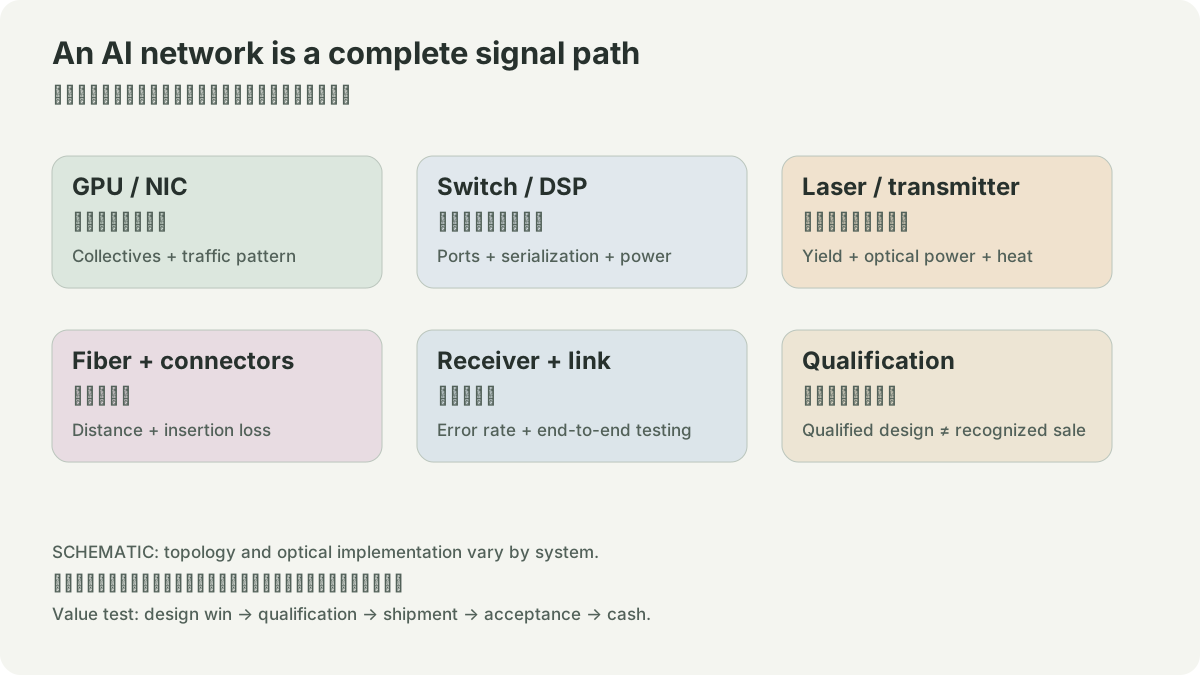
An accelerator or switch serializes data onto electrical lanes. Depending on the design, a DSP equalizes the signal or recovers timing; drivers and lasers convert it into light; fiber carries the light; photodiodes, receivers, and DSPs reconstruct electrical data. The useful question is not whether optics are “hot,” but where conversion, reach, power, heat, test time, and serviceability land. RFC 2544 benchmarking and RFC 4814 packet reordering provide technical vocabulary for the first boundary, while APPLIED OPTOELECTRONICS, INC. 8-K filed 2024-08-06 is a time-stamped company record. They are not interchangeable evidence. An interface label compresses lane count, modulation, host interface, optical reach, thermal envelope, and operations policy.
For planning, aggregate rate can be written as lanes times lane rate. Goodput is smaller because utilization, encoding, retransmission, congestion, and application communication shape it. A teaching equation is goodput equals port rate times observed utilization times one minus protocol overhead. It is not a performance measurement. Write every unobserved term as an assumption. RFC 2679 IP delay is useful for identifying what an interface name can mean; it cannot establish a supplier’s shipment volume or a customer deployment.
Why the next bottleneck moves
Shortening an electrical path by bringing optics nearer to silicon can improve one signal budget while making thermal design, repair, packaging yield, and replacement logistics more important. Replacing a short optical link with an active electrical cable can simplify one path while moving the reach and power boundary. Increasing production may move the constraint to lasers, assembly, burn-in, test, fiber, customer qualification, or working capital. “The next bottleneck” must therefore name a stage and a falsifiable observation. APPLIED OPTOELECTRONICS, INC. 8-K filed 2024-08-06 should be read for period-specific risks and accounting language before demand is converted into an assertion about cash.
Qualified capacity is not announced floor space. A useful operational decomposition is shippable units equal starts times yield times test-pass rate times acceptance rate. Each term has an owner and a failure mode. A purchase order, a forecast, shipment, customer acceptance, and recognized revenue are different events. Customer-concentration disclosures can show exposure without identifying a customer, a product, a contract term, or future volume. APPLIED OPTOELECTRONICS, INC. 10-Q filed 2024-08-06 and APPLIED OPTOELECTRONICS, INC. 8-K filed 2024-08-06 are separate primary records to compare, not proof that similar companies will have similar outcomes.
Read a financial record before a ratio
A 10-K or 10-Q is a dated accounting record. Before calculating anything, write fiscal period, currency, units, filing date, and whether a number is GAAP or non-GAAP. Revenue and gross margin can create questions about mix or utilization. Inventory and receivables can create questions about cash conversion. Operating cash flow can differ from earnings because working capital moves. No single line proves durability of demand. Keep a table with the exact filing URL beside every value; never merge a fiscal quarter with an access date.
A bull, base, and bear worksheet is useful only when it exposes conditions. A bull case might require qualification success, a better mix, stable yield, and bounded working capital. A base case can retain disclosed operating conditions. A bear case can include qualification delay, price pressure, inventory growth, or a competing interconnect. Put the disconfirming observation beside every case. This chapter intentionally does not produce a target price: discount rates, terminal assumptions, capital structure, and market prices would add assumptions not verified by these sources.
Reading lab
build three operating cases with no share-price output. Make four columns: released fact, vendor claim, independent measurement, and your calculation. For every sentence, record URL, publication date, access date, fiscal period, unit, and the narrow claim it supports. Do not copy a financial number until its table and period are visible. Do not compare a technical product until interface, reach, temperature, power, and test conditions are recorded. This is an offline exercise. It does not execute a trade, contact a supplier, or validate a deployment.
Evidence boundary from 2024 onward
The 2024-to-current story is not that every AI component is scarce. Accelerators, HBM packaging, NICs, switching silicon, copper, optical modules, lasers, fiber, and test equipment have distinct lead times and substitution paths. Pages without a published date are marked unknown and only prove access on 2026-10-04; they are not treated as a new release. No September 2026 financial result or stock quote is claimed without an article-specific dated primary source. Revisit this map when a filing changes segment, concentration, inventory, cash-flow, or revenue-recognition language, or when a dated technical release changes a qualified interface.
A valuation driver sheet using disclosed AAOI values
Do not turn the following into a price target. AAOI's 2025 Form 10-K, filed February 26, 2026, reports $455.715 million of annual revenue and $136.913 million of gross profit. The resulting 30.0% is a calculation from those two disclosed values. It is a starting state, not a normalized margin. The same filing reports $179.148 million of capital expenditures and negative $174.428 million of operating cash flow, so an operating-margin narrative that ignores investment and working capital is incomplete.
A base operating case can hold revenue mix, gross margin, inventory, receivables, capex, and cash conversion at explicitly chosen levels. A bull case requires evidence of qualification and mix improvement, then asks whether yield and cash conversion also improve. A bear case can impose a delayed customer acceptance or higher inventory without guessing a stock price. The June 2026 10-Q gives a second dated observation: $191.922 million revenue and $53.207 million gross profit in Q2 2026, with inventory and receivables of $278.791 million and $314.009 million at June 30. Use these only as period-labelled inputs; discount rates, terminal values, and market price are separate assumptions outside this chapter.
NETWORK / HYPOTHETICAL INPUTS
Port labels and useful throughput differ.
An 800 Gb/s port multiplied by the selected useful fraction. This toy fraction combines idle time and overhead; it is not a measured link or a protocol model. Tail latency, topology, retries and collective algorithms need separate measurements. It cannot predict a supplier’s sales.
SOURCES
01YOUR NOTES