Start with the observation that could prove you wrong
An optical-infrastructure thesis is useful only if it can lose. “AI needs more bandwidth” is a direction, not a testable claim about a laser, module, switch port, or supplier. A testable thesis names a technical boundary, an operating mechanism, a time window and an observation that changes the conclusion. For example: a supplier may benefit if a qualified product reaches customer acceptance at a planned rate; the thesis weakens if the qualification is delayed, an alternate interconnect wins the relevant reach, or working-capital and pricing evidence contradict the assumed conversion.
The AAOI 2025 Form 10-K and Q2 2026 Form 10-Q are periodic reports with stated periods. Read their financial statements, MD&A and risk disclosures as period-specific evidence. The linked financial source library is a bilingual chronology of 70 actual AAOI documents; it is a reading index, not seventy independent confirmations of one claim.
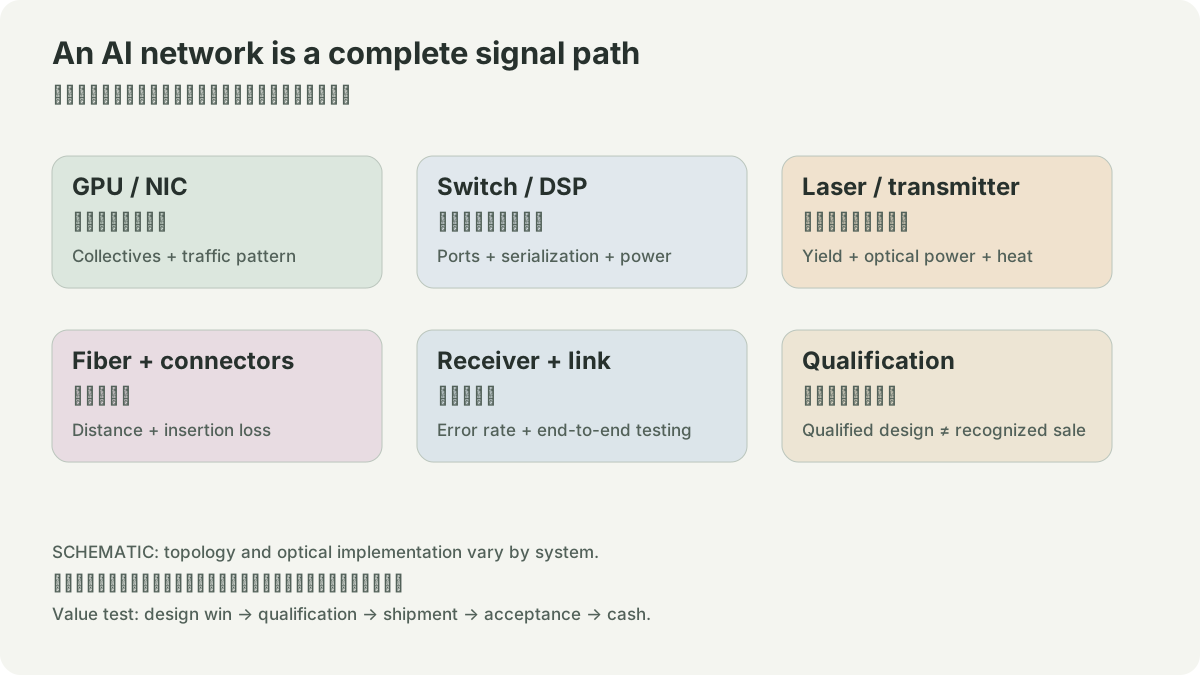
- 1Workload and topology
- 2electrical reach limit
- 3copper / AEC / optical choice
- 1optical design
- 2qualification
- 3yield and test
- 4shipment
- 5customer acceptance
- 1thesis assumption
- 2dated primary observation
- 3retain, narrow, or invalidate
Build four disconfirming lanes
The technical lane asks whether the assumed link boundary is still required. A shorter electrical path, an active electrical cable, a different fabric topology, or a newer optical packaging approach may serve the workload differently. A product announcement is evidence that a design exists; it is not proof of volume deployment or vendor share.
The customer lane asks whether a forecast converted into a firm order, a shipment, acceptance and revenue. The 2025 10-K says AAOI typically relies on individual purchase orders and that forecasts do not generally commit customers beyond firm orders. This makes cancellation, delay, mix change and second-source qualification direct invalidation candidates. It does not say that any particular future order will cancel.
The manufacturing lane asks whether the physical chain can deliver: laser and component availability, assembly, burn-in, test capacity, yield and returns. A capacity announcement does not establish qualified output. The accounting lane asks whether a stated revenue, receivable, inventory, margin or cash-flow movement is read with its period, currency, units and table context. A single measure can prompt a question; it cannot by itself settle a demand thesis.
Documents have different jobs
A 10-K is an annual periodic report; a 10-Q is a quarterly periodic report. They are the primary places to read the stated period's financial statements and management discussion. An 8-K is a current-event report. Item 1.01 can disclose entry into a material definitive agreement; it confirms the described agreement event, not revenue conversion. Item 2.02 concerns results of operations and financial condition and can point to an earnings release; read its status and attachment. Item 5.02 concerns directors, officers, appointments or compensation-related governance events; it is not an operating result.
The source library records a September 15, 2026 AAOI 8-K with Items 1.01 and 2.03, a financing/direct-obligation disclosure. It supports that disclosed transaction event. It must not be recast as a customer contract, product shipment or revenue confirmation. This form-and-item distinction prevents a common monitoring error: treating every new filing as equally strong proof of commercial demand.
Hypothetical dashboard and exercise
Suppose a research note assumes 800G module demand rises because a planned two-tier fabric needs 2,000 links. Make five rows: topology, customer release, qualified output, acceptance, and period financial result. For each row, specify one source, a date, a condition that would invalidate the assumption, and the action after observation. A delayed qualification may change the timing row but not the topology row; a financing 8-K may change capital-structure research but not demonstrate a link deployment. The 2,000-link number is invented for the exercise.
Run the exercise with one 10-K, one 10-Q and two 8-Ks from the library. Write what each document proves, what it cannot prove, and what next document would update the dashboard. Do not calculate a valuation or publish a growth rate without reading the relevant table and its units. The goal is a falsifiable research process, not an investment recommendation.
NETWORK / HYPOTHETICAL INPUTS
Port labels and useful throughput differ.
An 800 Gb/s port multiplied by the selected useful fraction. This toy fraction combines idle time and overhead; it is not a measured link or a protocol model. Tail latency, topology, retries and collective algorithms need separate measurements. It cannot predict a supplier’s sales.
SOURCES
01YOUR NOTES