A request is not electricity
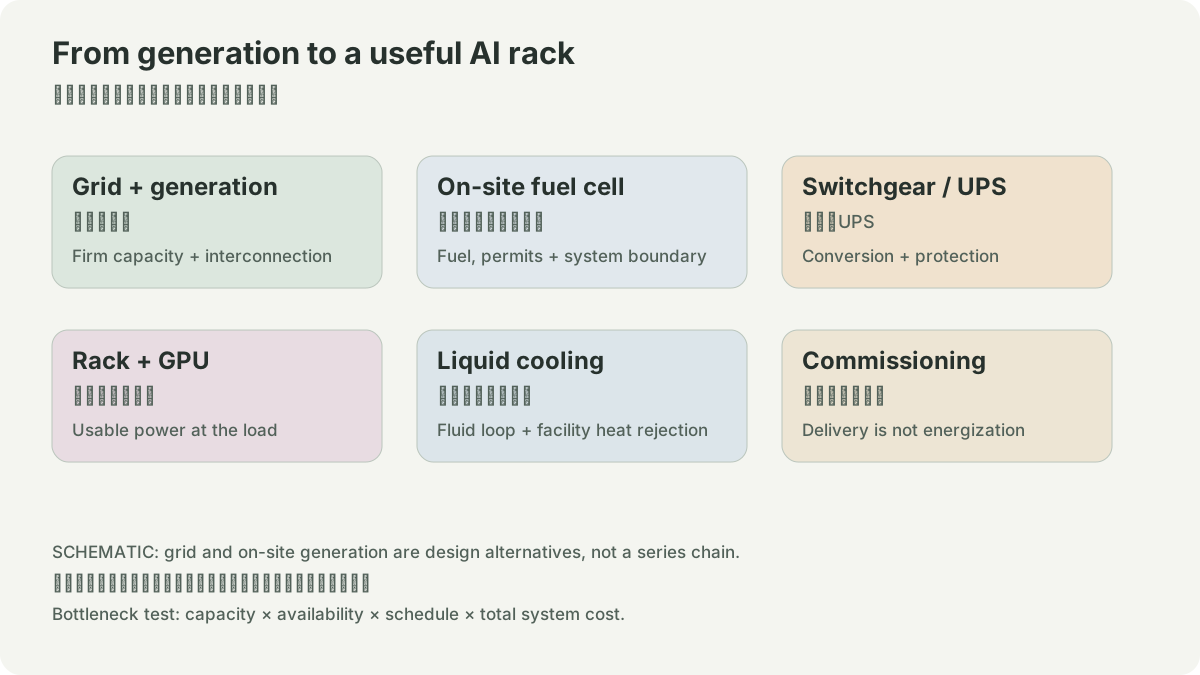
An interconnection request says that a customer wants a connection; it does not say that the network can serve the requested load on a firm date. A large campus usually moves through application data, power-flow and short-circuit studies, a facilities or upgrade scope, cost allocation, agreement execution, procurement, construction, testing, and operating procedures. Distribution utilities, transmission providers, RTOs/ISOs, regulators, and local authorities divide those steps differently. Treating every region as one queue produces bad comparisons.
FERC’s RM26-4 docket frames timely and orderly interconnection of large loads as a policy question and describes the proposed focus as loads generally above 20 MW (FERC). That is a live regulatory boundary, not a universal timetable. The authoritative timetable for a project is the applicable tariff and executed agreement.
Study outputs have conditions
A study may identify thermal overload, voltage, protection, stability, fault-duty, or resource-adequacy consequences. Its upgrade list can be revised when assumptions change: neighboring projects withdraw, load location changes, a generator retires, equipment ratings are updated, or the customer changes its ramp profile. A study’s MW figure should be read with its point of delivery, reliability criterion, seasonal assumptions, and whether it is non-firm, interruptible, or subject to curtailment.
FERC’s 2025 reliability conference materials describe large loads that can ramp rapidly and ask how planners should model uncertainty, ride-through, and load changes (conference record). This does not mean a data center is unreliable by definition. It means the electrical behavior of the particular campus matters as much as annual MWh.
Equipment makes the schedule physical
Even after an agreement, delivery depends on transformers, breakers, protection panels, cable, civil works, workforce, outages, and testing. The critical path can move: a customer may have secured land and servers while awaiting a utility substation; a utility may have capacity but require a customer-funded feeder; a completed facility may wait for energization. Record the item with the longest lead time and its current contractual owner instead of assuming “grid capacity” has one owner.
NERC’s 2025 assessment reports that planning entities are confronting unusually large requests and, in some regions, use adjustments rather than assuming every request will materialize (NERC LTRA). This supports a conservative model of project conversion. It does not tell us that any named developer will cancel.
Time to power has more than one clock
Keep four dates: requested service, study completion, contractual service date, and actual energized/accepted operation. A fifth date is useful for the customer’s required compute start. The gap between these dates is where temporary generation, phased load, demand response, or project redesign may appear. Such measures can improve sequencing but bring their own fuel, emissions, permit, financing, and backup obligations.
For a toy 150 MW request, do not call 150 MW “available” until the relevant operating test is passed. Model three states: 50 MW initially energized, 100 MW after site equipment, and 150 MW after network work. This is a teaching model only; it has no forecast content. Attach an explicit failure path for a delayed transformer, changed study, or utility curtailment.
Exercise
Obtain the public tariff for a chosen service territory and make a one-page evidence table. List the application, study, agreement, network upgrade, construction, and energization stages. Quote the tariff rather than a market report. Then write the one condition that would cause the planned data-center opening date to move.
- 1load request
- 2study assumptions
- 3upgrade scope and cost allocation
- 4executed agreement
- 1procurement and construction
- 2protection and commissioning tests
- 3energized service
- 1requested MW != contracted MW != tested operating MW
POWER / HYPOTHETICAL INPUTS
IT power is only part of facility energy.
Annual energy = IT MW × PUE × 80% load factor × 8,760 hours. PUE = facility energy / IT energy. This planning example ignores seasonal changes and availability; it does not establish grid connection, fuel consumption or generation efficiency.
SOURCES
01YOUR NOTES