What the product description establishes
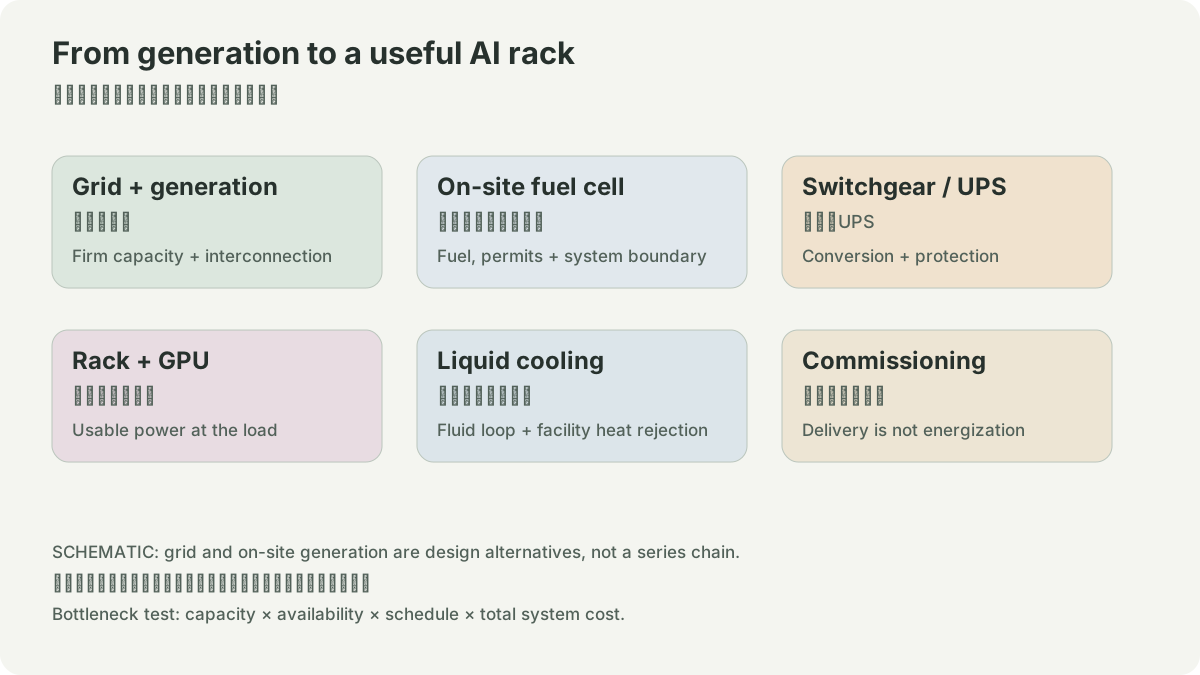
Bloom’s 2025 Form 10-K describes the Energy Server as a proprietary high-temperature solid-oxide fuel-cell system which converts natural gas, biogas, and hydrogen to electricity using an electrochemical, non-combustion process (10-K). This establishes the company’s description of its platform and business. It is not an independent result about lifecycle greenhouse gases, delivered availability, or project economics.
In simplified terms, fuel is conditioned at the fuel side of the cell, oxygen is reduced at the air side, and ions move through a ceramic electrolyte; electrons travel through the external circuit and do electrical work. High-temperature operation can enable internal reforming and useful exhaust heat, but it also makes thermal management, start/stop behavior, sealing, stack durability, and balance-of-plant maintenance important. The precise stack design is proprietary; do not invent material details from a generic SOFC diagram.
Fuel is a boundary, not a footnote
The product page says the system can use natural gas, biogas, or hydrogen (Bloom technology). Those fuels are not interchangeable environmental or commercial inputs. A credible site analysis records delivered fuel specification, pipeline or transport path, upstream methane assumptions, renewable-gas certificates if any, hydrogen production method, emissions permit, and the contract party responsible for supply. “Fuel flexible” describes capability; it does not prove that a particular deployment runs on a particular fuel.
Likewise, non-combustion does not mean zero emissions in every case. Direct electricity generation changes the conversion process, but natural-gas use retains carbon and upstream boundaries. A company statement about lower emissions or high efficiency is a provider claim unless an independent assessment compares the same electrical output, load factor, fuel, and system boundary.
Read operation as an availability system
An onsite asset must be evaluated as a system: fuel delivery, electrical interconnection, controls, cooling/air path, planned maintenance, replacement parts, service response, and backup arrangement. The data sheet describes modular, 24/7 operation and grid-parallel or microgrid architectures (data sheet); these are product capabilities, not a guarantee of site performance. Ask for the measurement period, availability definition, exclusions, and whether auxiliary equipment is included.
For an explicitly hypothetical example, a 20 MW unit at 90% utilization for 8,760 hours produces 157,680 MWh before any distinction between dispatch availability, curtailment, outages, or degradation. It says nothing about fuel cost, heat rate, emissions, or contractual availability. Those terms require their own data and should not be back-solved from a marketing statement.
Compare with a complete boundary
Compare an onsite system and a grid-connected design using the same columns: initial delivery date; N and N+1 topology; fuel and electricity price exposure; construction footprint; water and heat-rejection needs; permit path; carbon-accounting method; maintenance outage plan; and behavior during grid events. The relevant result may be a hybrid: grid service for energy and onsite equipment for resilience or interim supply. The choice is site-specific.
Exercise
For an imagined 20 MW deployment, write a meter plan with electricity output, fuel input, outage intervals, emissions stack/permit data, and renewable-attribute evidence in separate rows. Add one owner and one acceptance rule per row. Do not label unmetered claims as measured.
- 1fuel specification
- 2electrochemical stack
- 3DC power conversion
- 4site electrical load
- 1air, heat, controls, service and fuel delivery
- 2availability boundary
- 1provider product claim
- 2site meter and permit evidence
- 3comparable operating result
POWER / HYPOTHETICAL INPUTS
IT power is only part of facility energy.
Annual energy = IT MW × PUE × 80% load factor × 8,760 hours. PUE = facility energy / IT energy. This planning example ignores seasonal changes and availability; it does not establish grid connection, fuel consumption or generation efficiency.
SOURCES
01YOUR NOTES