A filing answers bounded questions
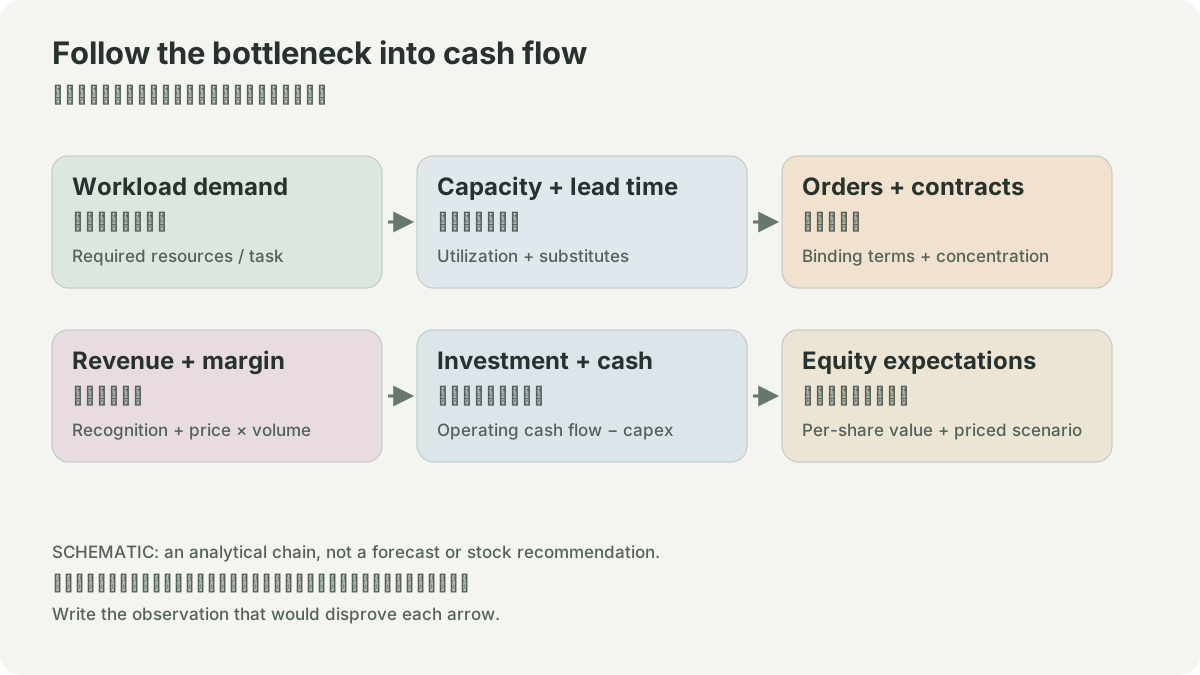
Financial statements are a dated measurement system. The income statement asks what revenue and costs were recognized in the period. The balance sheet asks what assets, liabilities, and equity existed at the period end. The cash-flow statement asks how cash moved through operating, investing, and financing activities. Notes, concentration disclosures, commitments, and risk factors add boundaries that headline numbers omit.
Use the filed 10-K and 10-Q, rather than a presentation alone, for the base record. Bloom’s 2025 10-K describes its product and service revenue model and its dependence on customer financing, supply arrangements, production, regulatory compliance, and liquidity (10-K). Its amended June 2026 quarterly filing is a later, period-specific record (10-Q/A). Do not combine their numbers without preserving period labels.
Separate profit from cash
Revenue is not cash collected, gross margin is not operating cash flow, and a cash increase is not necessarily operating profitability. Working capital can move cash when receivables, inventory, deposits, contract liabilities, or payables change. Financing can increase cash through debt or equity even if operations consumed cash. Conversely, a profitable period can have negative operating cash flow while a project is built or customers pay later.
For a compact filing card, record revenue, gross profit, operating result, operating cash flow, investing cash flow, financing cash flow, period-end cash, debt, and the notes that explain material changes. Then reconcile directions before interpreting them. A press release may highlight non-GAAP measures; use the reconciliation and label them non-GAAP. Bloom’s Q2 2025 release, for example, reported both GAAP and non-GAAP measures (release). Neither is a substitute for reading the filing.
Concentration and obligations can change the story
Customer concentration means a small number of customers can affect results, cash collection, and future demand materially. Supplier concentration, warranties, installation commitments, financing arrangements, and debt conversion terms can create different risks. Read the exact note and reporting period; do not infer a concentration percentage from customer logos or make an undated concentration claim.
Backlog and future demand are not current revenue. Similarly, a favorable gross-margin trend does not establish a future margin path. Any valuation discussion needs a set of explicit, revisable assumptions: delivery volumes, average selling price, service mix, costs, financing needs, dilution, debt terms, customer credit, and policy/fuel conditions. A filing does not support a target price or a guaranteed return.
Preserve the period and the unit
Before comparing two disclosures, normalize only what the issuer has made comparable. Keep quarter versus year-to-date, GAAP versus non-GAAP, and dollars versus percentages in visibly separate columns. Read whether a figure is a balance at period end, a flow during the period, or management guidance. The Q2 2026 filing records one completed reporting period; it is not evidence about activity after filing, unless a later filing or dated announcement states it.
This discipline also improves risk analysis. A material customer balance can affect revenue concentration, receivable collection, and future demand differently. A warranty reserve can indicate an accounting estimate, not a count of failures. Debt may fund manufacturing capacity, refinance obligations, or simply provide liquidity. Let the note identify the fact before imposing a narrative on it.
Exercise
Build a one-page card for one filing: period end and filing date; income trend; operating-cash trend; financing cash flow; cash and debt; material customer/supplier disclosures; and unanswered questions. Leave a cell blank where the filing does not answer it. Then compare the next filing only after matching definitions and periods.
- 1orders and acceptance
- 2revenue recognition
- 3income statement
- 1receivables, inventory, deposits and payables
- 2operating cash flow
- 1debt or equity
- 2financing cash flow
- 3period-end liquidity
POWER / HYPOTHETICAL INPUTS
IT power is only part of facility energy.
Annual energy = IT MW × PUE × 80% load factor × 8,760 hours. PUE = facility energy / IT energy. This planning example ignores seasonal changes and availability; it does not establish grid connection, fuel consumption or generation efficiency.
SOURCES
01YOUR NOTES