Start with the issuer and reporting boundary
Vertiv Holdings Co is CIK 1674101, while Bloom Energy is CIK 1664703. Verifying the registrant before reading a filing avoids an elementary but consequential error. Vertiv’s 2025 10-K describes a global critical-digital-infrastructure business spanning power, cooling, racks, software, and services, and reports 2025 net sales of $10,229.9 million (10-K). That is a fiscal-year result, not a forecast or a market-size estimate.
The same filing defines estimated combined backlog as product and services for which a purchase order or commitment has been received but delivery has not occurred, and notes that orders may be cancelled or rescheduled. It reports $15.0 billion at December 31, 2025. This is stronger than a generic pipeline claim because it has a stated definition and date, but it is still not revenue, cash, or guaranteed conversion.
Follow systems economics
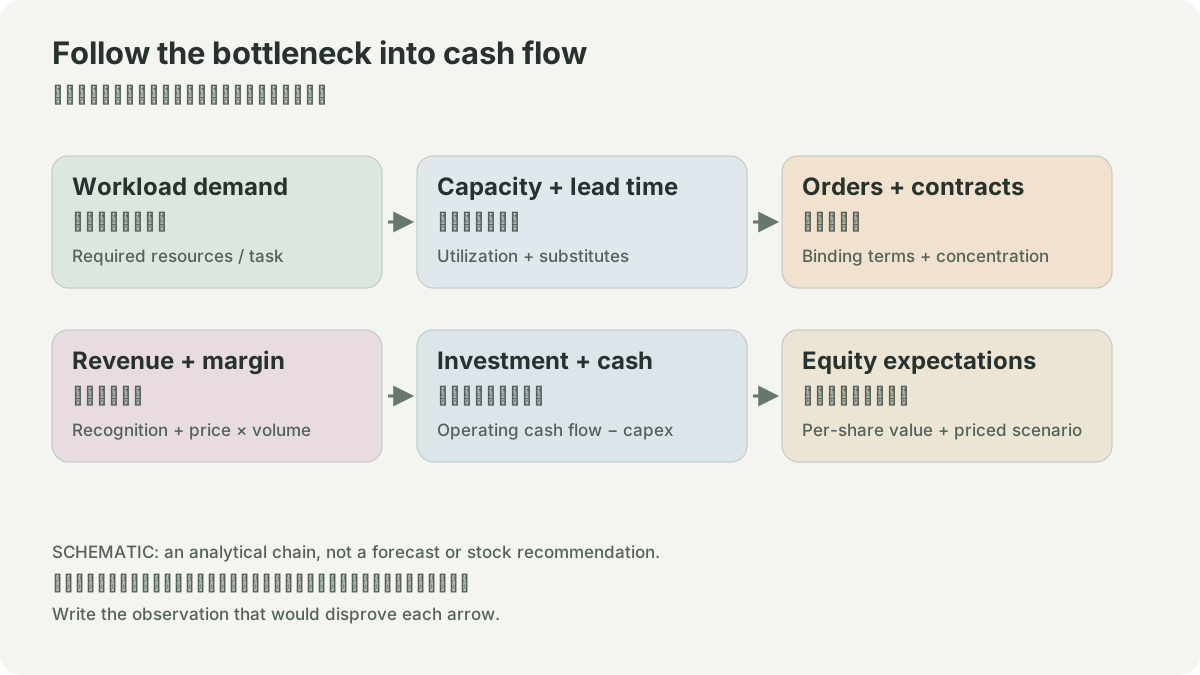
Power and cooling equipment is a system sale: customer demand can increase orders, but revenue depends on engineering, supply chain, factory capacity, installation, acceptance, and service. Gross margin can change with mix, price, material cost, warranty, freight, and execution. A backlog increase can also increase working-capital and delivery obligations. Read income, balance sheet, cash flow, and notes together.
Vertiv’s June 2026 10-Q reports quarterly net sales of $3,274.3 million and labels the comparison period explicitly (Q2 10-Q). The correct interpretation is period-specific: calculate changes only with matching definitions, then inspect the notes for drivers. Do not annualize a quarter without saying it is a mechanical scenario.
Valuation is conditional
A valuation model needs revenue timing, margins, working capital, capital expenditure, tax, debt, share count, and a discount rate. It also needs risks: customer concentration, project delays, supply constraints, competitive pricing, foreign exchange, warranty, tariff, and demand volatility. A higher data-center load forecast is an input to a scenario, not a conclusion about Vertiv’s earnings or stock price.
Build a base, upside, and downside case from explicit operational conditions. The constructive case can assume timely conversion of disclosed backlog and controlled costs. The adverse case can test cancellation, rescheduling, margin pressure, or working-capital growth. Neither case has predictive force until its assumptions are evidenced and updated.
Exercise
Create a filing card with issuer, period end, sales, backlog definition/date, operating cash flow, debt, shares, and material risks. Then create a valuation worksheet that leaves all unsupported assumptions blank. The blank cells identify research work; they are not invitations to invent precision.
Use the same care with peer comparisons. Different issuers may define backlog, service revenue, adjusted earnings, geographic exposure, and customer concentration differently. A multiple is a comparison of assumptions as well as a calculation. Match fiscal periods and share-count dates before comparing, and treat all provider market claims as claims unless independently verified.
The worksheet is finished when another reader can trace every historical number to a dated filing and identify every forward assumption. It should be revised when the next filing changes those inputs.
- 1customer order
- 2factory and project execution
- 3delivery/acceptance
- 4revenue and cash
- 1backlog definition
- 2cancellation/rescheduling conditions
- 3conversion scenario
- 1filed period data
- 2explicit assumptions
- 3conditional valuation range
POWER / HYPOTHETICAL INPUTS
IT power is only part of facility energy.
Annual energy = IT MW × PUE × 80% load factor × 8,760 hours. PUE = facility energy / IT energy. This planning example ignores seasonal changes and availability; it does not establish grid connection, fuel consumption or generation efficiency.
SOURCES
01YOUR NOTES