A low P/E can be a warning at the top of a cycle
Price divided by earnings is a compact question: what price is being paid for the chosen earnings denominator? It is not a complete answer about value. A memory company may report unusually high profits when supply is tight and prices are strong. If buyers use peak earnings as a permanent denominator, the stock can appear cheap immediately before profits normalize. Conversely a high multiple during a trough can reflect unusually depressed earnings. The relevant task is to estimate sustainable economics under explicit operating conditions, not to rank the smallest displayed P/E.
Sandisk's annual report provides year-to-year operating results and end-market composition. AAOI's reports provide a different combination of optical product revenue, investment and cash usage. Their cyclical exposures and capital structures cannot be collapsed into a common “AI stock” multiple. FINRA's ratio definitions are a starting vocabulary; the normalized cases below are original teaching models, not estimates for either issuer.
Rebuild earnings from operating assumptions
Suppose a toy memory supplier earns revenue of 1,000 and gross margin of 45% in a scarce-supply year. Operating costs are 150, producing operating profit of 300. With a hypothetical equity value of 3,000 and after-tax profit of 240, P/E is 12.5. Now normalize gross margin to 25% with the same revenue and operating costs: operating profit is 100 and, at the same assumed 20% tax rate, profit is 80. At the unchanged price, P/E becomes 37.5. The apparent bargain depended on a 45% margin persisting.
Change one assumption at a time. Lower unit demand while holding price fixed; then lower realized price; then change cost per unit and utilization. This identifies which driver produces the downside instead of burying five changes inside a “bear” number. For NAND, capacity sold and price per unit of capacity need consistent definitions. Product mix matters: an enterprise SSD is not equivalent to a raw bit shipment. For HBM, qualified stack supply and packaging yield are additional drivers. Do not assign HBM economics directly to a NAND business.
Earnings quality and reinvestment determine the cash claim
Normalizing earnings alone is insufficient. A company may need continuing equipment replacement, customer engineering and working capital to preserve its position. Depreciation is an accounting allocation; equipment purchases are dated cash transactions. Equipment can be owned directly or funded through joint ventures and related arrangements. Reading only one PP&E purchase line can understate the economic funding needed for manufacturing capacity. Inspect commitments, venture funding and contractual purchase obligations alongside the cash-flow statement.
A toy business with normalized net profit of 100, noncash depreciation of 40, equipment purchases of 70 and an additional working-capital need of 20 produces an illustrative cash remainder of 50. This simplified bridge omits other adjustments and is not a formal financial-statement line. If maintenance investment consumes the cash that was mistaken for distributable profit, a low P/E can become a value trap. If an investment temporarily depresses cash but later produces a durable return above its funding cost, the conclusion can be different. The operational evidence must distinguish those cases.
Reverse the valuation question
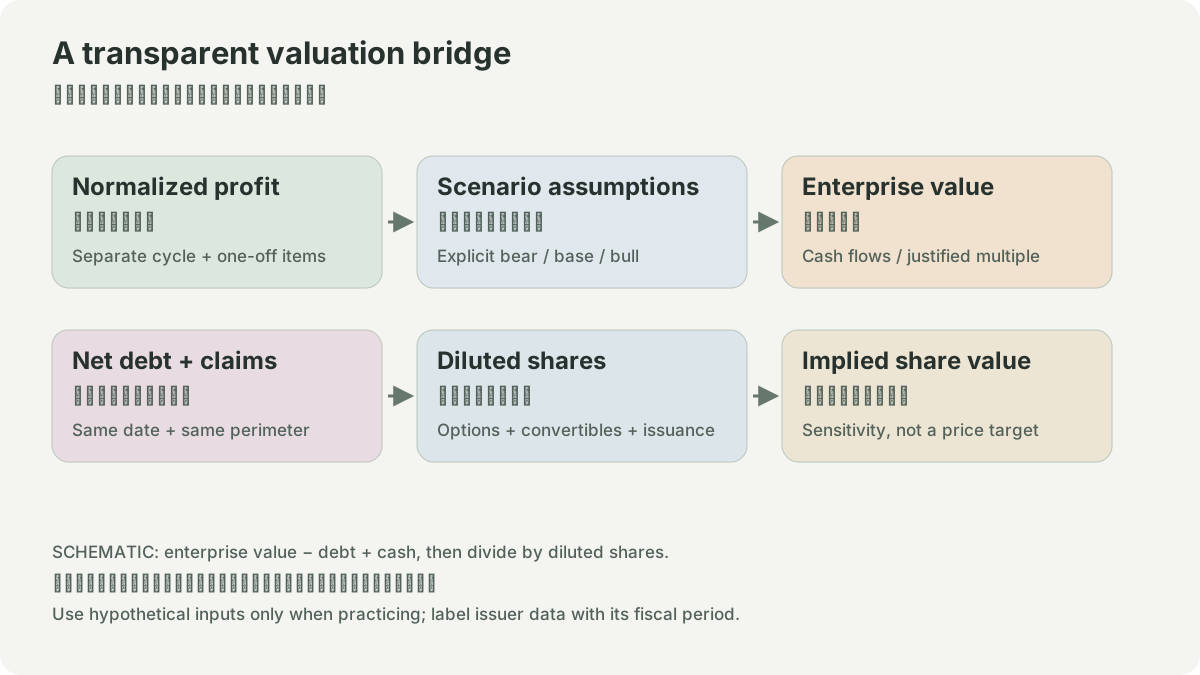
Instead of asking “what multiple should I use?”, ask what operating performance the observed value would require. A fictional equity value of 4,000 at a normalized P/E of 20 implies profit of 200. At a 10% net margin, it requires revenue of 2,000. With 100 million diluted shares, the value per share is 40 monetary units; increasing shares to 120 million reduces it to about 33.33 if the equity value is unchanged. These calculations expose a condition, not a target for SNDK, BE or AAOI.
Use conservative, central and favorable cases with explicit mix, margin, investment and diluted ownership. Check the balance sheet for funding resilience, and state which observed data would contradict your sustainable earnings estimate. A favorable industry theme can coexist with an expensive stock. A low ratio can coexist with deteriorating returns on capital. Value research is the work of explaining the difference with evidence.
A reading exercise with a stopping rule
Choose two completed fiscal periods in one issuer's filings. Write the actual revenue, gross margin, operating costs, CFO and manufacturing funding commitments. Then create a separate normalized column whose cells are clearly assumptions. Identify the single assumption to which your conclusion is most sensitive. Stop and mark the valuation incomplete if you cannot explain the capital requirement or diluted ownership. Adding decimal places cannot repair an undefined denominator.
VALUATION / HYPOTHETICAL INPUTS
How much does one assumption change value?
Toy model: current annual cash flow 500m, debt 1,000m, cash 200m and 100m diluted shares. EV = cash flow × (1 + g) / (r − g); equity = EV − debt + cash. It assumes immediate perpetual growth and ignores a transition period and other claims. No issuer inputs or target prices are used.
SOURCES
01YOUR NOTES