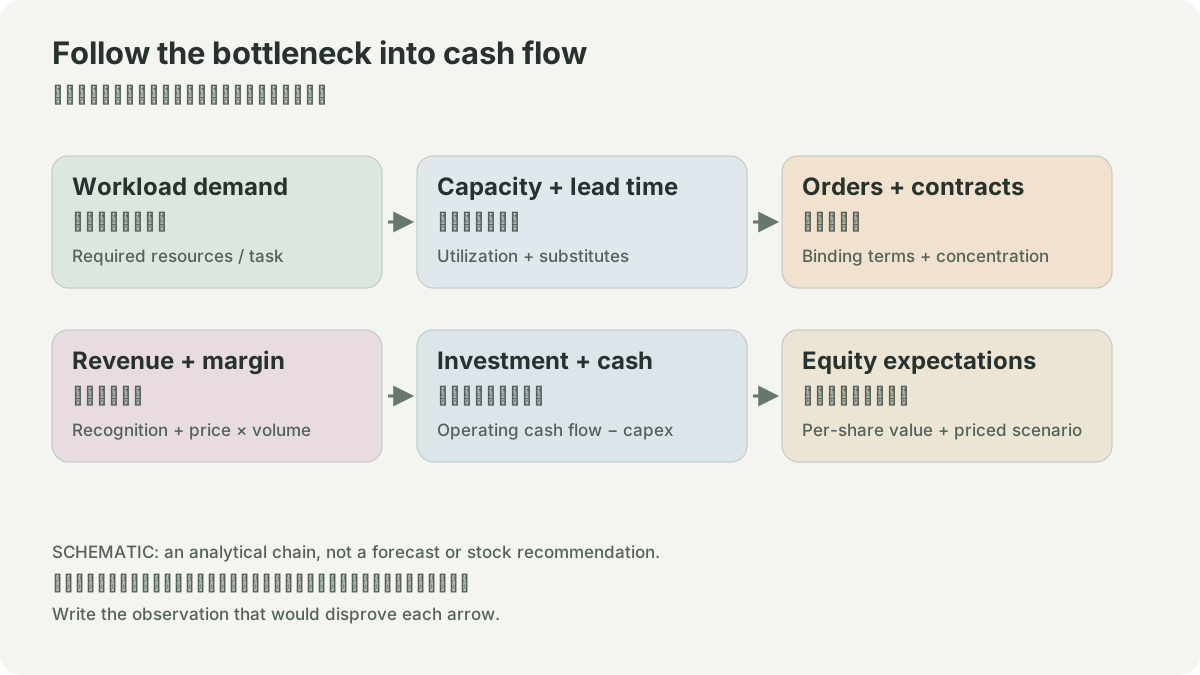
Start with a labeled GAAP table
For SanDisk’s fiscal year ended July 3, 2026, the Form 10-K reports GAAP net revenue of $20.248 billion, cost of revenue of $5.776 billion, and gross profit of $14.472 billion: a 71.5% gross margin. It reports GAAP operating income of $12.389 billion and GAAP net income of $11.433 billion. FY2025 comparatives were revenue $7.355 billion, gross profit $2.212 billion (30.1%), operating loss $1.377 billion, and net loss $1.641 billion. These are income-statement measures, not cash receipts.
- 1revenue - cost of revenue = gross profit
- 2operating expenses = operating income
- 1net income + noncash items + working-capital changes = operating cash flow
- 1operating cash flow - PP&E purchases is a cash lens, not GAAP profit
The same FY2026 GAAP cash-flow statement reports $11.671 billion cash provided by operations and $177 million purchases of property, plant and equipment. It also reports $970 million purchases of marketable equity securities, $462 million notes receivable issued to Flash Ventures, $187 million proceeds on such notes, and $4.524 billion common-stock repurchases. Do not label all investing cash as capex: PP&E purchases are the stated capex-like line; securities and venture financing are different uses.
Working capital explains why profit and cash differ
In FY2026, accounts receivable increased by $3.640 billion and inventories increased by $619 million in the cash-flow reconciliation—both uses of operating cash. Refund liability increased by $1.374 billion, contract liabilities by $1.217 billion, and income taxes payable by $1.370 billion, which supported cash flow in that reconciliation. These are period changes, not permanent sources of cash. A model that annualizes them as recurring margin would be wrong.
The 10-K lists 147 million basic and 155 million diluted weighted-average shares for FY2026, with GAAP basic and diluted EPS of $77.78 and $73.76. Weighted-average shares explain that year’s EPS denominator; they are not necessarily the closing share count on any quote date. The balance sheet says 146 million shares were outstanding at July 3, 2026, after 149 million issued, and separately reports treasury stock. Keep average shares, period-end shares, and market prices in separate fields.
Toy scenario and invalidation
Suppose next year’s revenue is held flat at $20.248 billion in a toy model. A one-point gross-margin decline removes about $202 million of gross profit before tax and operating-expense effects. That is arithmetic, not a forecast. The model must separately state product mix, price per gigabyte, bit volume, yields, inventory, and operating costs. It also needs a cash model: a faster receivable build can reduce cash even when revenue and GAAP margin rise.
Exercise. Recreate five labeled lines from the 10-K: revenue, gross profit, operating income, CFO, and PP&E purchases. Reconcile gross margin yourself as gross profit/revenue. Then list which line would invalidate a “cash conversion improved” claim: CFO, receivables, inventory, capex, or an item outside these. Use the FY2026 10-K for each value and retain its FY-end date and GAAP label.
ROOFLINE / HYPOTHETICAL INPUTS
Does memory feed the compute?
Upper bound = min(compute ceiling, bandwidth × arithmetic intensity). Decimal TB = 10¹² bytes. Cache effects, access patterns, communication and actual utilization are omitted; this is not a device benchmark. More capacity does not necessarily increase bandwidth.
SOURCES
01YOUR NOTES