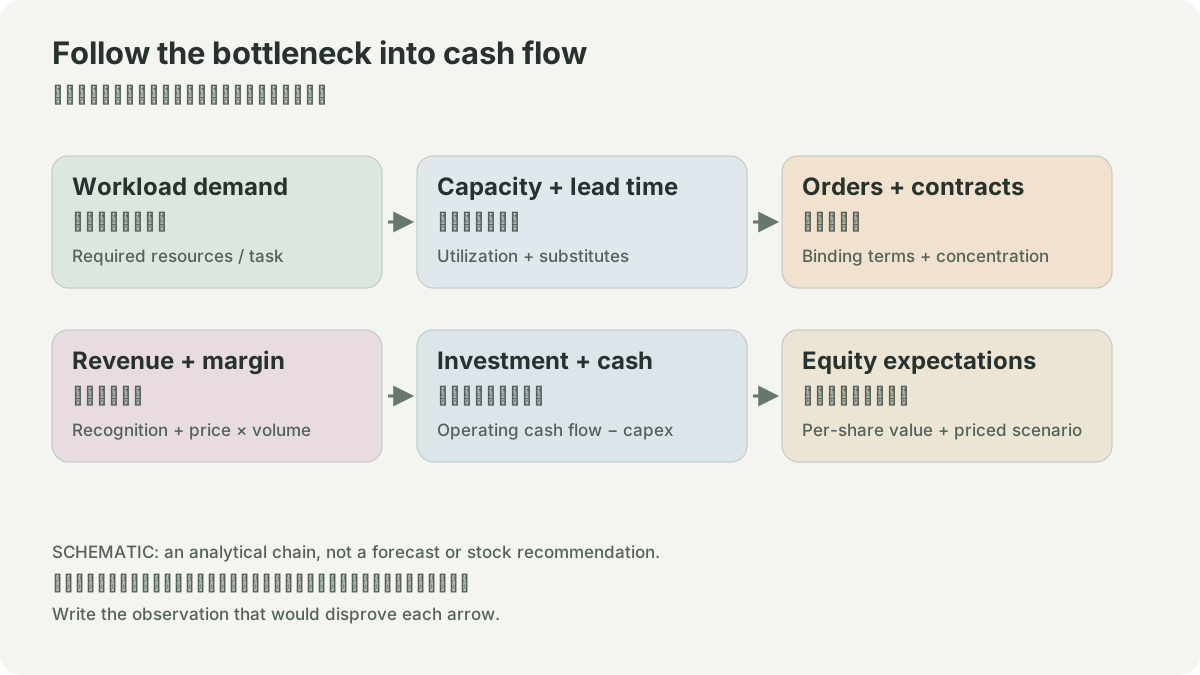
Economics begins after the technical claim
An HBM announcement can establish what a company says it developed, sampled, or plans to produce. It cannot by itself establish revenue, gross margin, yield, customer allocation, or market share. SK hynix’s September 2025 announcement says it completed HBM4 development and was preparing mass production. That source is useful product-roadmap evidence on its publication date. It should not be rewritten as an audited financial result.
- 1DRAM process + base die + stack assembly
- 2qualified HBM
- 3customer platform
- 4realized price and cost
- 1technical claim
- 2supply/qualification evidence
- 3accounting result
- 4economics conclusion
HBM economics differ from a simple commodity-bit model because the sellable unit depends on several constrained stages. DRAM die density and yield affect available inputs. TSV, bonding and test affect stack yield. Logic/base-die choices, advanced packaging, substrates, thermal performance and customer qualification affect what can ship. Product mix matters: a higher-capacity or higher-performance stack may consume different die counts and packaging resources. The cost, price and output effect cannot be inferred from a pin-rate headline alone.
SK hynix and TSMC said in their April 2024 announcement that they would collaborate on next-generation HBM, including the logic base die and advanced packaging. The announcement supports the relationship and stated technical focus. It does not disclose the commercial terms, allocation, final product cost, or realized yield. Treat external foundry/packaging collaboration as a dependency that may reduce or add constraints, not as proof of a particular margin.
A deliberately hypothetical contribution model
Use variables, not invented company facts. Let P be realized revenue per qualified stack, V the number of qualified stacks shipped, and C fully loaded cost per stack. Gross profit is (P − C) × V; gross margin is (P − C) / P. If a toy program improves final stack yield from 90% to 92% using the same input population, sellable output rises by about 2.2% relative, before any cost of the improvement. If it adds expensive test time or reduces throughput, the cost term can offset the output benefit. This is a sensitivity tool, not SK hynix’s yield or margin.
Separate price from mix. A revenue increase can result from more stacks, higher capacity per stack, higher realized price, a different customer mix, or timing. Separate cost from utilization. Fixed manufacturing costs can make gross margin sensitive to output, but a high utilization rate does not overcome a qualification failure or package shortage. Finally, separate reported profit from cash: inventory, receivables, capex and partner funding have their own timing.
Exercise: evidence-first economics
Create a table with four columns: claim, primary source, what it proves, and what remains unknown. Enter “HBM4 development completed” as a product claim; enter the linked SK hynix release; state that it proves the issuer made that announcement; list yield, price, volume and margin as unknown. Then make a toy sensitivity with explicitly labeled assumptions and two invalidations: a competing qualified product and packaging/test capacity that limits output. This preserves useful engineering insight while refusing to manufacture a financial result.
ROOFLINE / HYPOTHETICAL INPUTS
Does memory feed the compute?
Upper bound = min(compute ceiling, bandwidth × arithmetic intensity). Decimal TB = 10¹² bytes. Cache effects, access patterns, communication and actual utilization are omitted; this is not a device benchmark. More capacity does not necessarily increase bandwidth.
SOURCES
01YOUR NOTES